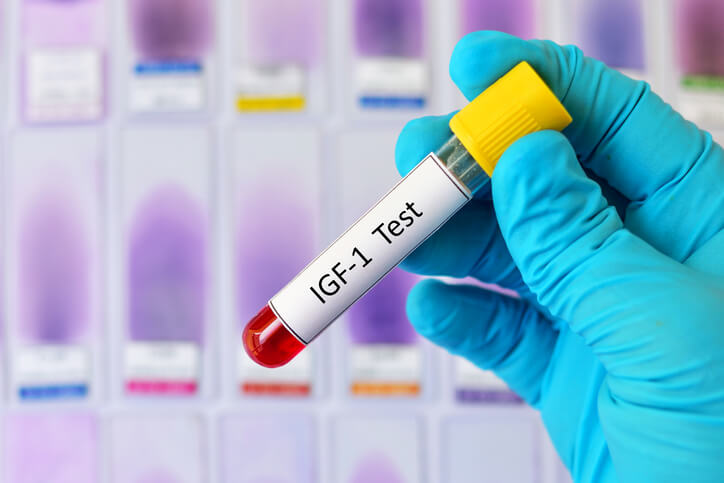
Adult-onset or “age-related” growth hormone deficiency, both abbreviated “AGHD” is a real medical condition. However, it is a little more complicated to diagnose than other age-related hormone issues like low testosterone. Rather than a simple blood test that measures the amount of human growth hormone (HGH) in your blood,
Testing for AGHD involves another HGH related hormone know as Insulin-like Growth Factor 1 or “IGF-1.” Because growth hormone levels fluctuate significantly throughout the day, healthcare providers measure IGF-1 instead. IGF-1 acts as a stable proxy, remaining relatively steady and providing a clear picture of your overall growth hormone activity
Let’s look at how our doctors test for and diagnose HGH issues in adults, how to interpret those results, and how we treat GHD.
What is IGF-1?
Insulin-like growth factor 1, or IGF-1, is a hormone that helps carry out many of the effects of human growth hormone in the body. Growth hormone is released by the pituitary gland. It then signals the liver and other tissues to produce IGF-1. Together, these hormones help control growth, repair, and healthy tissue function.
Doctors often measure IGF-1 when they want to learn more about a patient’s growth hormone levels. Growth hormone rises and falls throughout the day, which can make a single growth hormone blood test hard to read. IGF-1 remains more stable. For this reason, an IGF-1 blood test can provide a clearer first look at growth hormone activity.
How Is HGH Deficiency Diagnosed in Adults: IGF-1 Testing and More
If you over 40 and have been feeling “off” for a while, you are not alone. Many adults notice changes like low energy, more body fat, less muscle tone, weaker recovery, poor sleep, and brain fog. When these changes stack up, it is normal to wonder if your growth hormone level has dropped with age.
The good news is this, hormone lab testing can determine if HGH decline is the root of the problem. At The HGH Therapy Doctor, we use a step-by-step process that helps you understand what is happening in your body and what to do next.
The Most Common Tests for Diagnosing Growth Hormone Deficiency
Growth hormone is released in “bursts,” not in a steady stream. That is one reason testing has to be done in a very specific way. Instead of relying on a single random growth hormone blood draw, doctors often use two key tools, IGF-1 testing and growth hormone stimulation testing.
These tests work together to give a more complete picture of your growth hormone activity and your pituitary function.
IGF-1 testing: the most common starting point
IGF-1 is a blood marker that reflects growth hormone activity over time. Think of it like a “steady mirror” of what your growth hormone system has been doing recently.
A simple IGF-1 blood draw can be a strong first step because it is stable and easy to measure. It can also be used later to help track how your plan is working.
What Are the Normal IGF-1 Levels in Adults?
There is no single normal IGF-1 level that applies to every adult. Healthy levels change with age and may also differ between men and women. IGF-1 is usually highest during the teen years and early adulthood. It then tends to fall slowly as a person gets older.
However, as a general rule, most labs list adult male ranges of about 155 to 432 ng/mL from ages 21 to 30, 121 to 237 ng/mL from ages 41 to 50, and 60 to 220 ng/mL from ages 61 to 70.
Female ranges are about 87 to 368 ng/mL, 118 to 298 ng/mL, and 75 to 263 ng/mL for those same age groups. These numbers are examples only and should not replace the range on a patient’s own report.
Growth hormone stimulation testing: a deeper confirmation test
A stimulation test checks how well your pituitary gland can “respond” when your body is prompted to release growth hormone.
During this test, you are given medication that signals your body to release growth hormone. Then blood samples are taken at set times to see how strongly your level rises.
This type of test can be especially helpful when a clear answer is needed, or when your doctor wants to confirm the full picture before moving forward.
What Are the Normal HGH Levels for Adult Men and Women?
This is one of the most common questions, and the most important answer is simple:
“Normal” depends on the test, your age, and the lab’s reference range.
Here is why:
- Growth hormone levels can rise and fall quickly, even within the same day.
- IGF-1 ranges change by age, and reference ranges are often adjusted by sex, too.
- Different labs use different testing methods, which can slightly change what is considered “in range.”
So instead of chasing a single number you found online, the best approach is to review your results with a physician who understands how to interpret them in context.
At The HGH Therapy Doctor, we focus on what your results mean for you, not just what a number says on paper.
Understanding IGF-1 and HGH Test Results
Once your testing is complete, your physician will review the findings in detail with you. This is the most important part of the process, because numbers without context do not tell the full story. Your physician will usually review:
- Your IGF-1 level compared to the reference range for your age and sex
- Your stimulation test response (if you completed one)
- Your symptoms and how long they have been present
- Your health history, medications, sleep patterns, and lifestyle factors
- Any other lab findings that could affect energy, weight, mood, and recovery
This is also where your care becomes personal. Two people can have similar lab values and still need a different plan. Your doctor’s job is to connect the dots and help you move forward with confidence.
What happens next (your treatment roadmap)

After your review, you will typically move into one of these next steps:
- Clear reassurance and guidance if your results are in a healthy range
- Additional testing if your doctor wants a sharper view of pituitary function
- A personalized treatment plan if your results show low growth hormone activity and your symptoms match
If your HGH and IGF-1 test results indicate insufficient hormone production, you may be diagnosed with adult growth hormone deficiency. For adults, this means your pituitary gland is no longer producing enough growth hormone to support key functions such as metabolism, cellular repair, and healthy brain performance.
Getting that diagnosis can feel like a lot at first. But it is also empowering. Once you know what is happening, you can finally take focused steps to restore balance through growth hormone therapy.
When prescribed and monitored by experienced physicians, HGH therapy can be a safe and effective way to rebuild momentum. Many patients notice benefits such as better energy and stamina, stronger lean muscle support, improved fat metabolism, a brighter mood and sharper focus, stronger bones, better sleep quality, and improved sexual wellness.
Most importantly, blood test results are not the end of the story. They are the beginning of a clear treatment journey that can help you feel strong, steady, and confident again.
Comparison of HGH Blood Tests
| Test |
Purpose |
Reliability |
When It’s Used |
Preparation |
| IGF-1 Test |
Measures insulin-like growth factor-1, a stable reflection of HGH activity |
High reliability for long-term HGH activity |
First-line test for suspected adult deficiency; also used to monitor response |
None (simple blood draw) |
| HGH Stimulation Test |
Checks pituitary response after a stimulant medicine |
Very reliable for confirming deficiency |
Used when IGF-1 is low or when confirmation is needed |
Usually fasting; medicine given before timed blood draws |
| HGH Suppression Test |
Checks whether HGH can be lowered appropriately |
Reliable for detecting HGH excess |
Used when HGH excess is suspected, not typical for deficiency workups |
Usually fasting; glucose or other agent may be used |
| Baseline Metabolic Panel |
Reviews related markers like glucose, liver enzymes, and more |
Moderate; supportive information |
Helps round out the full health picture |
Often fasting for best accuracy |
| Thyroid & Other Hormone Panels |
Checks other hormone issues that can affect symptoms |
High for ruling in/out related hormone drivers |
Helps confirm your symptoms are tied to the right cause |
None (simple blood draw) |
How Do I Prepare for an IGF-1 Test?
Preparation depends on the exact test your doctor orders. We will give you clear instructions on how to prepare for your prescribed test, but here are some general preparation tips:
For a basic IGF-1 blood test, you may not need special preparation. Still, it helps to show up well-hydrated and well-rested. No fasting is required. Simply stop consuming biotin (vitamin B7) for at least 72 hours before your blood draw, as it can skew results, and follow any specific instructions given by your healthcare provider.
What Do the Results of Your IGF-1 Test Mean?
Your results help answer two big questions:
- Is your growth hormone activity lower than expected for your age?
- Do your symptoms match what the labs are showing?
If both align, it can point toward an HGH deficiency pattern that is worth treating. If they do not align, your doctor may look at other drivers that can cause similar symptoms, so you still get answers and a plan that fits.
This is also why your follow-up visit matters so much. Your physician will not just “hand you lab numbers.” They will explain what they mean, what stands out, what looks healthy, and what steps make sense next.
The goal is clarity and direction.
Are There Ways to Naturally Boost IGF-1 Levels?
Healthy lifestyle habits may help support the body’s natural production of growth hormone and IGF-1. However, these steps cannot always correct a true hormone deficiency. Adults with very low IGF-1 levels or ongoing symptoms should speak with a doctor and receive proper testing.
Ways to naturally support healthy IGF-1 levels may include:
- Exercise on a regular basis. Strength training and short periods of higher-intensity exercise may support the natural release of growth hormone.
- Eat enough protein. Protein gives the body the building blocks it needs to maintain muscle, repair tissue, and support normal hormone production.
- Avoid extreme diets. Severe calorie cutting, poor nutrition, and rapid weight loss may lower IGF-1 levels.
- Get enough restful sleep. The body releases much of its growth hormone during deep sleep. Poor sleep may interfere with this normal process.
- Maintain a healthy body weight. Carrying too much body fat, especially around the waist, may affect normal growth hormone release.
- Limit heavy alcohol use. Drinking too much alcohol can harm sleep, liver health, and the body’s normal hormone balance.
- Manage long-term stress. Ongoing stress may affect sleep, eating habits, exercise, and other factors tied to hormone health.
- Treat underlying health problems. Thyroid disorders, liver problems, poor nutrition, and other medical concerns may affect IGF-1 levels.
No food, exercise plan, or over-the-counter supplement can reliably treat adult growth hormone deficiency. If healthy lifestyle changes do not improve symptoms, further testing may be needed to determine why IGF-1 levels are low.
How Do We Treat Growth Hormone Deficiencies?
If your testing supports it, treatment is built around a personalized HGH therapy plan that fits your body and your goals.
At The HGH Therapy Doctor, care is guided and measured. That means:
- The dose is selected carefully for you
- Progress is tracked over time
- Your plan is adjusted based on how you feel and how your body responds
- Follow-up testing may be used to confirm you are on the right track
This is not a one-size-fits-all approach. It is a physician-led program designed to help you feel better in a steady, reliable way.
What Kind of Results Could I Expect From Growth Hormone Therapy?

Most patients come to HGH therapy because they want to feel like themselves again.
While every person’s timeline is different, many adults describe improvements like:
More daily energy, better recovery after workouts, stronger lean muscle support, easier fat control, better sleep quality, and improved mental sharpness. Many people also report a better overall sense of well-being and motivation once their body feels “supported” again.
A key point: results are often best when therapy is consistent and monitored. That is where expert care makes a real difference.
How Does Growth Hormone Therapy Work?
Growth hormone therapy works in a very simple way: it helps replace what your body is no longer making enough of. As adults get older, the pituitary gland often slows down. This can happen so gradually that you do not notice it at first. Then one day, you look back and realize you have been feeling tired, softer, slower, and less like yourself for a long time.
That is the moment many people start looking for answers. And that is where growth hormone therapy can be a real turning point.
When your doctor prescribes HGH therapy, the goal is not to “overdo” anything. The goal is to achieve balance. Your physician is working to bring your hormone activity back into a healthier range so your body can do the things it is designed to do every day—build and keep lean muscle, manage body fat, recover after stress or exercise, support deep sleep, and maintain steady mental sharpness.
A simple way to think about what HGH does in the body
Your body is always doing quiet “behind the scenes” work. Even when you are sitting still, your cells are repairing. Your muscles are rebuilding. Your metabolism is adjusting. Your brain is sorting and storing information. Your body is also making decisions about what to keep—like lean muscle—and what to store—like fat.
Growth hormone supports many of those everyday functions. It helps your body stay in a “repair and rebuild” mode, which is one reason it is so closely tied to how you feel as you age. When growth hormone levels drop too low, the balance shifts, and your body breaks down more than it can build back up. This means that you get tired faster. You recover slower. Your strength does not come back like it used to. Your waistline grows even when your habits have not changed. Your sleep feels lighter. Your mood feels flatter. Your mind feels foggier.
HGH therapy is designed to help reverse that pattern by restoring support where your body needs it most.
How HGH therapy is typically given
Most HGH therapy programs use small, measured doses that are prescribed by a physician. The dosing is personalized. Your provider is not guessing. They are using your lab results, your symptoms, and your overall health picture to create a plan that fits you.
Many patients take HGH as a simple injection. If you are nervous about that, you are not alone. Most people are at first. But in real life, it is usually much easier than they expect. The needle is small, the process is quick, and it becomes part of a simple routine.
For many adults, the routine feels empowering. Instead of waking up and hoping today is a “better day,” you feel like you are taking control and building consistent progress.
Is Growth Hormone Therapy Right for Me?
This is one of the most important questions you can ask. And it deserves a real, clear answer! Growth hormone therapy is right for you when three things line up:
- You have symptoms that match a low growth hormone pattern
- Your testing supports the diagnosis
- You want a physician-guided plan designed for safe, steady results
If those three pieces fit, HGH therapy can be an excellent way to start feeling yourself again!
Many adults live with low growth hormone symptoms for years before they realize there is a name for what they are feeling. They often assume it is “just aging” and try to push through it. But deep down, they know something has changed.
Common signs that can point toward AGHD include:
- You feel tired even after sleep.
- You feel weaker than you used to.
- Your workouts do not seem to help much.
- Your overall exercise capacity drops
- Your body holds onto fat more easily.
- Your muscles feel softer.
- Your mood feels dull.
- Your mind feels foggy.
These symptoms can impact your quality of life in a big way. They also often affect confidence. You might feel like you are losing your edge.
However, proper lab testing as we have been discussing, is the only way to know if growth hormone therapy is really right for you. At The HGH Therapy Doctor, this process is designed to be simple and supportive. Testing typically starts with IGF-1, and when needed, your provider may recommend a stimulation test to confirm the full picture.
Once testing is complete, you do not just get a number. You get a clear review and an action plan. That is where most patients feel the biggest shift. They stop guessing. They stop wondering if it is “all in their head.” They finally have something concrete to work with.
What if I’m not sure yet?
If you are still not sure, that is completely normal. You do not need to decide today. However, if you recognize any of the symptoms above and think you might be suffering from low than normal HGH levels, the smartest first step is still testing. Testing gives you facts. Facts create clarity. Clarity makes the decision easier. Even if you are on the fence, a simple consultation and lab review can help you understand your options and feel confident about your direction.
Why Come to The HGH Therapy Doctor to Have Your HGH Tested?
HGH testing and treatment work best when the provider knows exactly what to look for and how to guide the next step.
At The HGH Therapy Doctor, our focus is simple. We help adults identify low growth hormone patterns, understand their lab results, and move into a personalized treatment plan designed to maximize success and minimize side effects or adverse events.
Patients choose us because we make the process easy to understand, we treat you like a real person and we build plans that are careful, customized, and focused on results!
If you are ready to stop guessing and start getting answers, why not contact us today, and join the many others who have learned how HGH therapy can put you on the path to peak performance at any age!